How it works
Built around the load, not the order
This is the structural difference, and it is the one that decides whether the software fits the shop or the shop works around the software.
The model
A charge is not an order, and an order is not a charge
A generic ERP models an order, moves it through operations, and treats the furnace as a resource the order occupies for a while. That works for machining. It breaks immediately in heat treat, because the furnace does not process orders — it processes charges, and a charge is assembled from whatever fits together at the same temperature under the same recipe.
So the relationship is many-to-many in both directions at once, and both directions have to be first-class.
Model it any other way and the shop ends up keeping the truth in a spreadsheet beside the system: which parts were actually in the furnace together, and which of a line's pieces went through which charge. That spreadsheet is the thing an auditor eventually asks to see.
Pricing
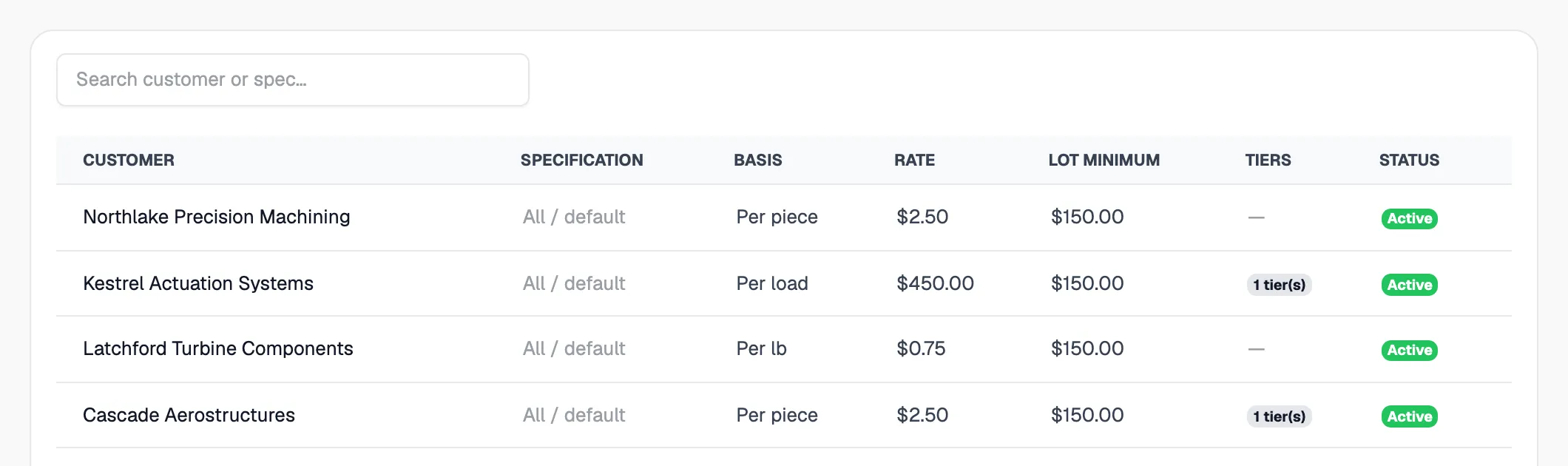
Per piece, per pound, or per load
Heat treat is quoted three different ways, often by the same shop on the same day, and sometimes with a lot minimum underneath. Per piece for small hardware, per pound for bulk, per load for a furnace someone has effectively booked.
Rates resolve from the line, then the customer's price list, and arefrozen onto the order when applied — so an invoice bills the basis that was quoted, not whatever the price list says months later. Per-pound work converts through real units, which is why a 200 kg line bills as 440.92 lb rather than a rounded guess.
Traceability
From mill heat to certificate, in one search
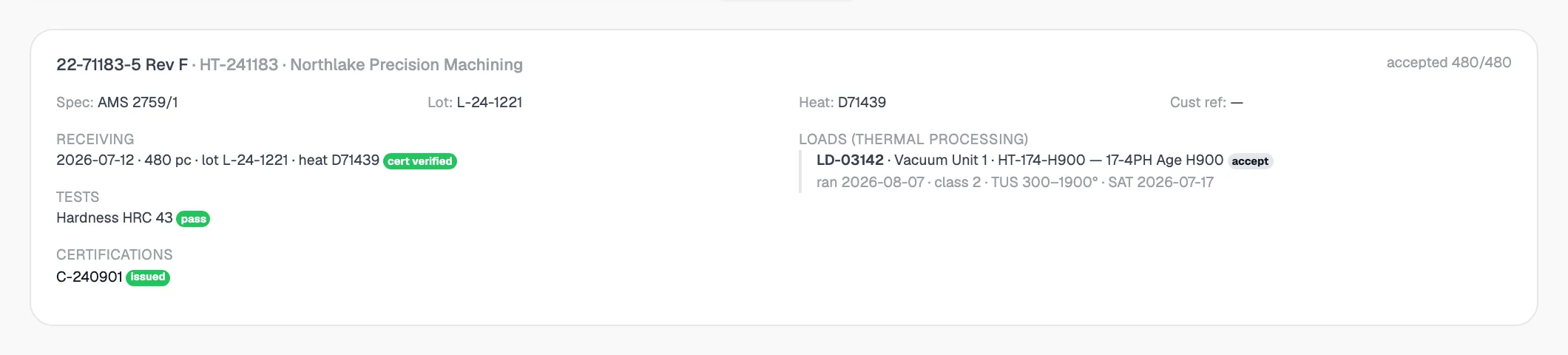
Because the load is a real object rather than a note, the chain joins up without anyone maintaining it. Search a lot number, a mill heat, a part, an order or a customer, and the whole path comes back: what was received, which charges it ran in, the cycle actuals and pyrometry for each, what was tested, and which certificate it left on.
This is the question that arrives by phone on a Friday afternoon — which of our parts were in that furnace — and it should take a search box, not an afternoon.
See it against your own work
Bring a real order that ran through two furnaces, and we'll trace it end to end in the demo.