Heat-treat ERP · Aerospace
The operating system
for a heat-treat shop.
Orders, loads, pyrometry and certificates in one place. The AI reads the PO and drafts the routing; the furnace refuses any load whose SAT is out of date. The compliance stays exact — the paperwork drafts itself.
The problem
You already know where the exposure is
Your pyrometry lives in a spreadsheet and your traceability lives in a system from 2003.
The spreadsheet is not the problem. The problem is that nothing connects it to the furnace. A SAT lapses on a Tuesday, work keeps running on Wednesday, and nobody finds out until someone reconstructs the record — for an audit, or because a prime asked.
By then the load has shipped. The question stops being is the process controlled and becomes can you prove it was controlled on the day. Those are very different questions, and only one of them can be answered after the fact.
Running Visual Shop or Bluestreak? Both have now been given retirement dates.What that means, and what has to move →
Automation
The rigor is exact. The paperwork drafts itself.
Compliance has to be exact, so the software is. Data entry does not — and in most shops that is where the day goes: re-keying a customer's PO into an order, hunting down the right routing, rebuilding a recipe someone already built last month.
- The PO reads itself in.
Drop in the customer's purchase order — a photo or a PDF — and HeatLock reads back the part, the routing and the furnace cycle, each flagged as matched to what you already have, or missing and worth creating.
- Routings, recipes and work instructions come drafted.
Not typed into a blank form. The system proposes them from what the job needs and what the shop has run before, so the work is checking a draft rather than authoring from scratch.
- Every draft stops at a human.
Nothing the AI produces is saved until someone confirms it. On a Nadcap floor that is not a limitation — it is the requirement. The AI removes the typing, never the judgement.
So the record behind every certificate is assembled as the work happens instead of by hand at audit time — and the person doing it is reviewing the work, not re-typing it.
The gate
The furnace refuses the load
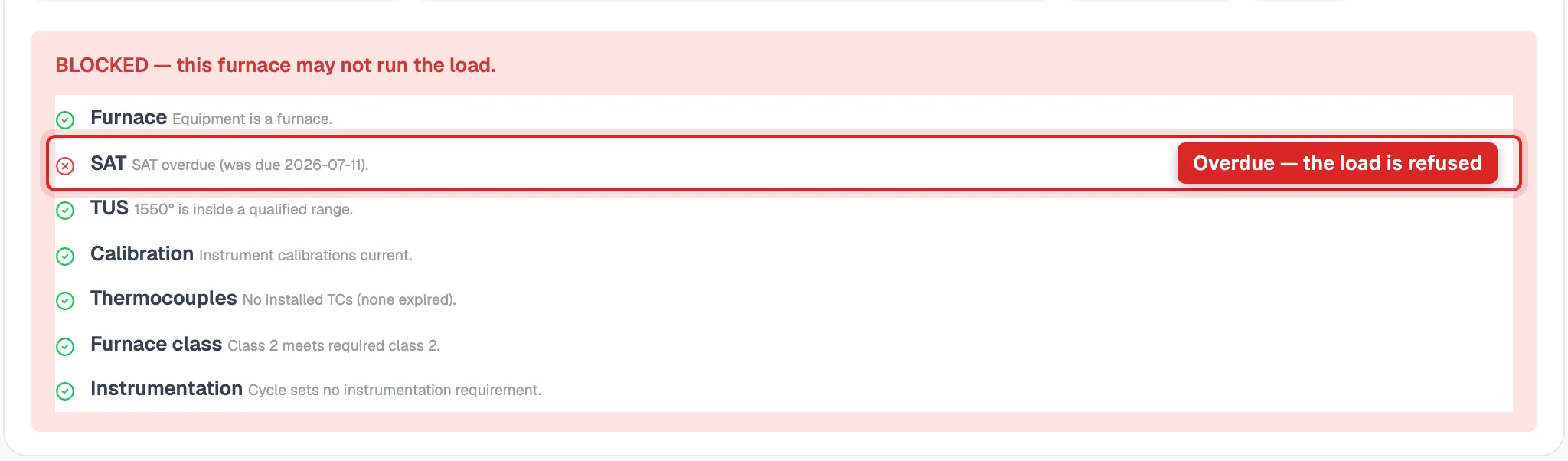
Before a charge is built, HeatLock asks one question of the furnace: can it runthis cycle at this temperature today? System accuracy test, temperature uniformity survey, instrument calibration, thermocouple usability, furnace class and instrumentation type — fused into one answer.
An out-of-compliance furnace is refused, and the refusal names the reason. Not a warning someone can dismiss at 2am. A refusal.
Walk the whole auditor's path — thermocouples to audit pack →
The model
The load is a first-class object, not a note on an order
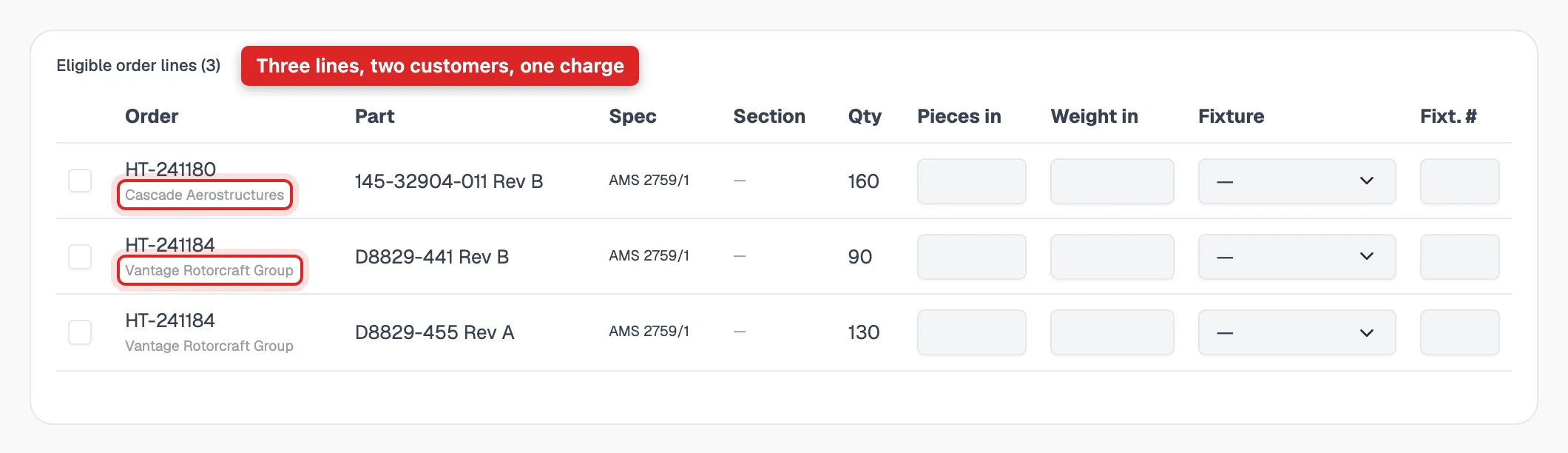
A heat-treat shop does not run orders through furnaces. It runsloads — and one load carries parts from several customers, while one order line passes through several loads. Every ERP that models the order and bolts the furnace on as an afterthought gets this backwards, and the shop pays for it in spreadsheets.
When the charge is built, the resolved recipe and the pyrometry evidence in force at that moment are frozen onto the load. Not referenced — frozen. Re-calibrate the furnace next week and last week's load still tells the truth about last week.
The deliverable
The certificate recites the evidence, not a claim
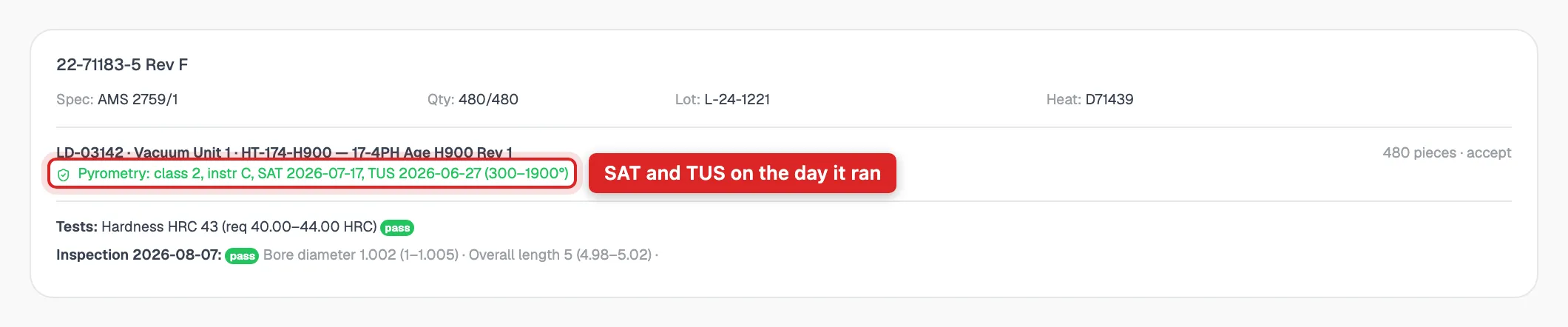
What the customer buys is not the heat treat. It is the piece of paper that says the heat treat was done to specification and can be proven. So the certificate recites the actual loads, their cycle actuals, and the pyrometry record that was in force when each one ran.
Issuing it is a signature — capability-gated and re-authenticated — and an issued certificate is immutable. Wrong means void and re-issue, which is what an auditor expects to see.
Provenance
Built from inside the shop, not for it
HeatLock was not built by a software company that interviewed a heat-treat shop. It was built by someone who worked in one — writing custom software to fix that shop's own processes, from the inside, long before any of it was a product.
That is why this page opens with a furnace refusing a load instead of a features grid. The gate, the pyrometry frozen onto every charge, the certificate that recites its own evidence — none of it came from a requirements document. It came from watching what actually goes wrong: a load that should never have run, a certificate that took an afternoon to assemble by hand, a pyrometry record nobody could find on the day it mattered.
See it refuse a load
A 30-minute walkthrough against your own furnace list and specifications. No pricing page, no trial signup — a conversation with someone who knows what AC7102/8 asks for.